Beyond the Cape and the Stake: Vlad Țepeș, the Man Behind the Halloween Myth

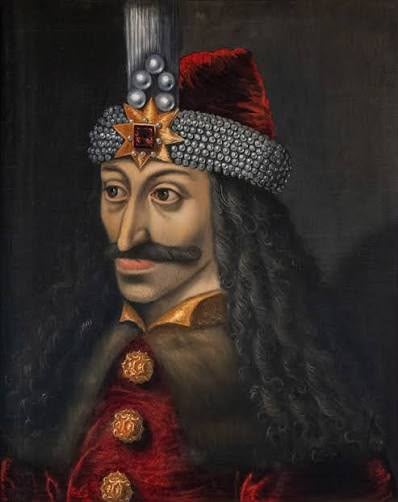
Few pause to ask about the flesh-and-blood man whose name the fictional vampire borrowed.
That man was Vlad III, better known as Vlad Țepeș—Vlad the Impaler—Prince of Wallachia in the 15th century.
His story is far more complex, and in many ways more compelling, than the undead legend that later swallowed it.
Born around 1431 in Sighișoara in Transylvania, Vlad was the second son of Vlad II Dracul.
His father belonged to the Order of the Dragon, a chivalric fraternity founded to defend Christendom against the expanding Ottoman Empire; the name “Dracul” (dragon, and later also devil in Romanian) passed to his son as Dracula or Drăculea—“son of the dragon.”
Vlad’s youth was shaped by the brutal politics of the region.
As a boy he and his younger brother were held as hostages at the Ottoman court to guarantee their father’s loyalty.
He later watched his father and older brother meet violent ends at the hands of rivals.
These experiences forged a ruler who would rule Wallachia in three short, turbulent reigns: briefly in 1448, then from 1456 to 1462, and finally in 1476.
Vlad governed a frontier principality squeezed between the Kingdom of Hungary and the Ottoman Empire.
To hold power he crushed internal opposition with extreme severity.
Impalement—the slow, public, and terrifying method of execution that earned him the Romanian epithet Țepeș—became his signature.
Contemporary accounts, many written by his Saxon and Hungarian enemies and amplified by the new printing press, describe forests of stakes, mass executions of boyars and merchants, and scenes of calculated terror.
Modern historians note that the numbers were almost certainly inflated by propaganda, yet the core reality remains: Vlad used spectacular cruelty as a tool of statecraft and deterrence in an age when such methods were not unknown.
Yet the same man is remembered in Romania as a national hero and defender of the land.
In 1462 he launched a daring campaign against Sultan Mehmed II, the conqueror of Constantinople.
The famous “Night Attack” near Târgoviște and the subsequent “forest of the impaled” that greeted the Ottoman army were acts of total war designed to halt the advance of an empire that had already swallowed much of the Balkans.
Vlad framed his struggle in explicitly religious terms.
In a letter to the Hungarian king Matthias Corvinus he wrote that he fought “for the preservation of Christianity.”
He founded monasteries, made donations to Mount Athos, and insisted on Christian burial even for those he condemned.
Pope Sixtus IV recognized his role in the defense of the faith by granting him the title Athleta Christi—Champion of Christ—the same honorific given to other Christian military leaders who resisted Ottoman expansion, such as Skanderbeg and Stephen the Great.
The transformation of this hard-edged Orthodox (and later briefly Catholic) prince into a blood-drinking vampire occurred centuries later.
In 1897 Bram Stoker published Dracula.
Stoker had never visited Romania and knew little of Vlad’s actual biography.
He found the name “Dracula” in a historical footnote, liked its association with “devil”, and grafted it onto a Transylvanian setting drawn from folklore and Gothic convention.
The real Vlad had ruled Wallachia, not Transylvania; Bran Castle, today’s popular “Dracula’s Castle”, had no meaningful connection to him.
The vampire myth absorbed the name and the aura of cruelty while discarding the political and religious context.